
Radio Audience Surge After Nielsen PPM Qualifier Change

Nielsen’s updated Portable People Meter (PPM) rules have led to a noticeable increase in measured radio audiences, according to new industry research.
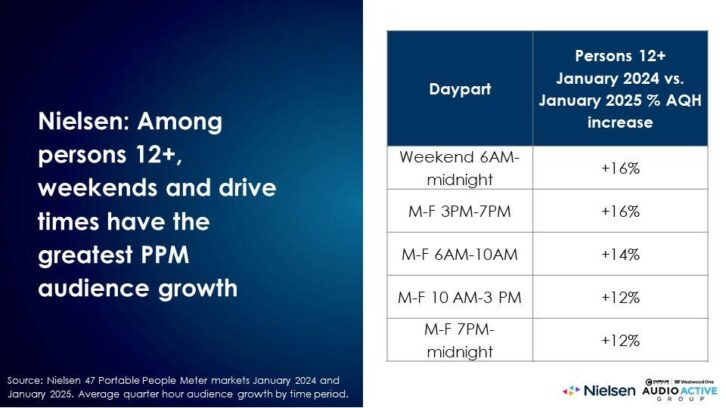
In January, Nielsen shortened the listening time required for a station to receive credit for an Average Quarter Hour (AQH) from five minutes to three. The January 2025 PPM data is the first to include this change. A study by the Active Audio Group found that AQH listening among people aged 12 and above rose by 16% compared to January 2024.
Pierre Bouvard, chief insights officer at Cumulus Media/Westwood One’s Active Audio Group, noted in a blog post that 23% of PPM listening sessions lasted three or four minutes. Under the old five-minute threshold, none of those sessions would have counted toward ratings. The new qualifier means those shorter sessions now contribute to audience totals, boosting numbers across the board — especially among younger listeners.
“Total U.S. AM/FM radio listening is up 3 percent,” Bouvard wrote.
Pierre Bouvard says ”the updated ratings now offer a clearer, more accurate view of how people engage with AM/FM radio.” He pointed to analysis by Scott Ankenstein, VP of research at Westwood One, who reviewed the January PPM data. The PPM system covers 47 U.S. markets, representing about one-third of the national population.”
Bouvard called the results a positive development for radio overall. While the methodology change has sparked optimism in some corners of the industry, others remain skeptical. Some critics see it as a cosmetic fix—improving the optics without addressing deeper concerns like weak ad revenue.
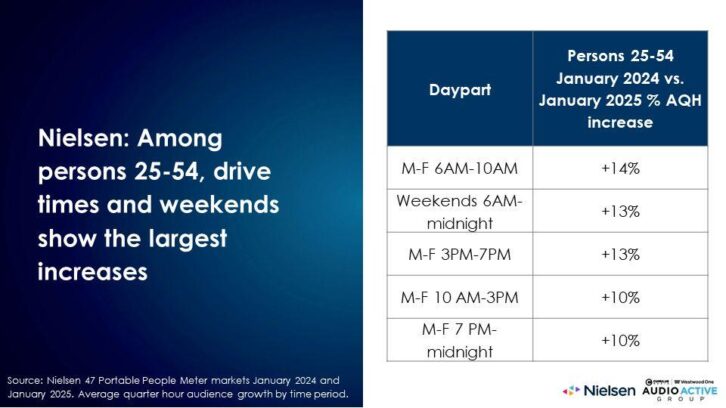
The data shows clear gains. Compared to January 2024, this year’s AQH numbers rose by double digits across all time blocks for audiences aged 12+ and 25–54. The biggest growth came during weekends and drive times.
Bouvard attributes that to more in-car listening during those periods, often in short bursts. These include school runs, shopping trips, and other quick stops—now counted under the revised three-minute rule.
YEAR TO YEAR CHANGES
The Active Audio Group found that AQH listening jumped by double digits across all dayparts compared to January last year, both for the 12+ audience and the 25–54 age group.
The biggest gains were during weekends and drive times. According to Pierre Bouvard, that’s likely because these periods involve more in-car listening, which often includes brief sessions—like trips to the store, school drop-offs, or quick errands—that are now counted under the new three-minute rule.
“These three- and four-minute occasions of listening are now being credited,” Bouvard wrote.
In the PPM markets, the analysis found that AQH shares by format stayed mostly consistent. Formats like adult contemporary and urban saw little change. A small increase in news/talk AQH was likely tied to a busier news cycle, not the methodology shift.
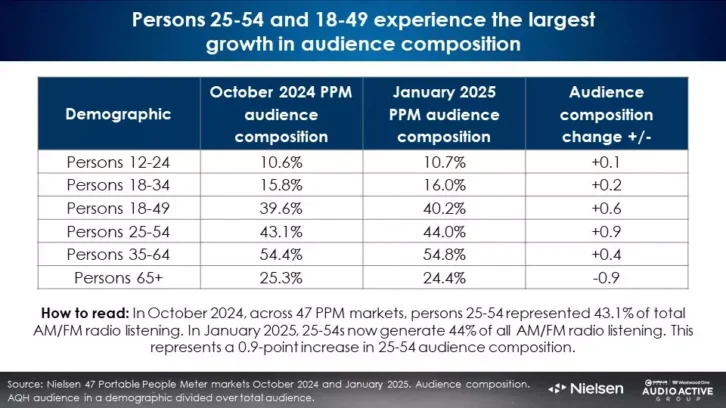
The study also pointed to audience growth among younger listeners. The only group that saw a drop in audience share was those aged 65 and older, whose composition shrank under the new rules.
Scott Ankenstein also ran a national AQH analysis, combining January 2025 PPM market data with diary market data from the previous year. He found that AQH listening rose 2% among 18–49-year-olds and 3% among the 25–54 group.
Back in October 2024, PPM markets made up 36% of all AM/FM listening for the 25–54 demo. By January 2025, that figure rose to 38%. That shift could appeal to network radio advertisers who track listening in larger, PPM-measured markets when evaluating buys.
Key summary
The study identified four major implications of PPM listening increases:
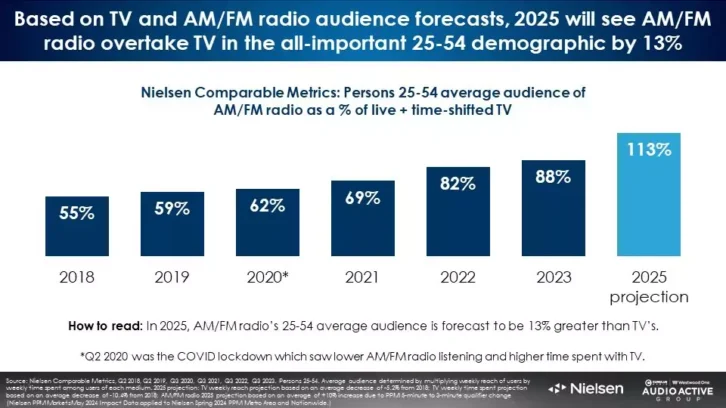
Radio is expected to widen its ratings advantage over TV. Pierre Bouvard says ”AM/FM radio will surpass TV in the key 25–54 demo in 2025 and grow its lead among 18–49s, based on current audience projections.”
Media plans built on 2024 data will outperform. According to Bouvard, media schedules using Nielsen’s Nationwide survey will see low single-digit gains in delivery. He attributes this to carryover from last year’s schedules, with variations depending on how much of the lineup relies on diary versus PPM markets.
AM/FM radio is also set to gain reach in ad campaigns. With PPM now capturing more short listening sessions, campaign reach numbers will rise.
Bouvard also sees an opportunity for radio ads to become more effective. He suggests stations will move toward more frequent, shorter ad breaks, now that the three-minute AQH qualifier gives them more flexibility. Many stations currently cluster two breaks at :15 and :45 past the hour, designed for the old five-minute rule. Shifting to shorter breaks could make advertising more impactful.